
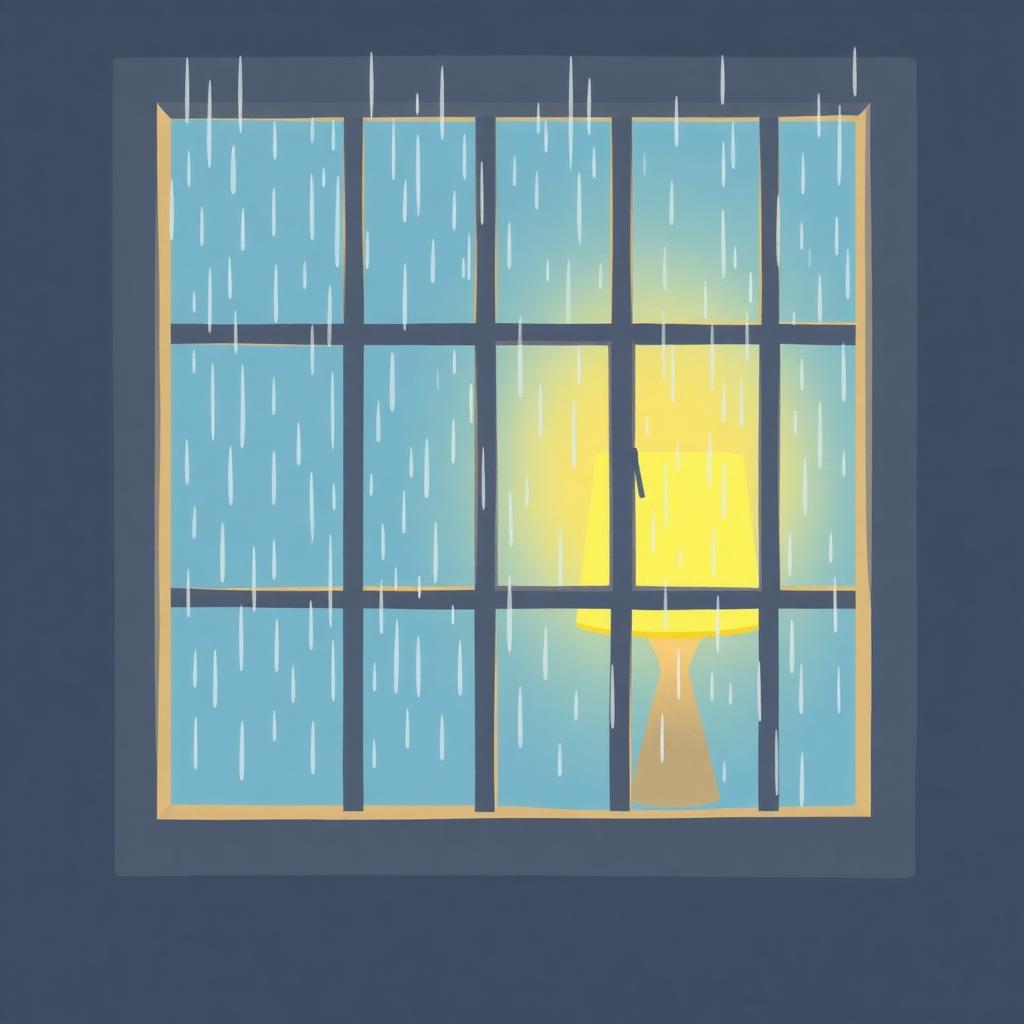
Sleep story · Sleep
Rain on the Roof
Elena Marsh · 30 min
30:00
remaining
What to do, minute by minute
1. Get comfortable
0:00–7:30Dim the lights, put your phone face-down, and lie down as if you were already going to sleep. Nothing here needs your effort.
2. Let the words carry you
7:30–15:00Don't try to follow the story closely. Let the images drift past — half-listening is exactly right.
3. Soften the body
15:00–22:30Unclench your jaw, drop your shoulders into the bed, and let your breathing slow on its own.
4. Drift
22:30–30:00If you fall asleep before the end, the session has done its job. If you're still awake, just keep resting — that counts too.
A long, quiet story told from a small room while the rain keeps time.
Read the full script
At the top of a narrow house, beneath a sloping roof, there is a small and quiet room.
The room is simple. It holds a low bed, a wooden chair, and a little table beside the window. A folded blanket rests at the foot of the bed. A book lies closed on the table, its place kept by a pale blue ribbon.
Outside, rain falls steadily.
It touches the roof in countless soft taps. Some drops land lightly. Others arrive with a fuller, rounder sound. Together they make an easy pattern, always changing and always the same.
The rain keeps time for the room.
It moves along the tiles. It gathers in shallow channels. It slips over the edge of the roof and descends through a copper gutter, where the sound becomes low and hollow.
Inside, the room stays warm.
A small lamp glows on the table. Its shade is the color of cream, and its light settles gently over everything nearby. It warms the closed book. It catches the smooth grain of the chair. It reaches the edge of the blanket, then fades before it arrives at the far wall.
The person staying in the room has been here for several days.
Each evening has its own weather. One evening brought a clear sky, with faint stars above the chimney pots. Another brought a breeze that moved through the lane and rustled the leaves of the old trees.
Tonight belongs to the rain.
It began in the late afternoon as a scattering of drops against the window. By dusk, the stones in the lane had darkened. Small streams had appeared beside the curb. Water shone on the steps and gathered in the shallow marks left by many passing feet.
Now the night is deep and settled.
Nothing asks to be done.
A cup stands empty beside the lamp. A trace of warmth remains in the pottery. The cup is broad and plain, with a handle worn smooth at the top. Earlier, it held warm milk with a little honey. Now it holds only the quiet scent of sweetness.
The person in the room lies beneath the covers and listens.
Rain on the roof.
Rain at the window.
Rain slipping down the gutter.
Every surface gives the water a different voice.
On the highest tiles, the drops sound small and bright. Near the eaves, they sound softer, as though they are landing on moss. At the glass, they arrive with delicate clicks, then travel downward in wavering lines.
One drop pauses near the upper corner of the window.
It gathers another drop, and then another. Slowly, it becomes heavy enough to move. It draws a silver path down the pane, bends around a tiny speck of dust, and joins a wider stream below.
Beyond the window, the garden is dim.
A stone wall encloses a square of grass and a few low shrubs. There is a pear tree near the center, old enough that its branches lean in thoughtful directions. Its leaves shine when the clouds thin and a little moonlight reaches them.
Tonight, the tree receives the rain without hurry.
Water rests along each narrow twig. It beads on the last leaves of the season. At the tips, droplets grow until they fall into the grass, where they disappear with sounds too small to hear from the room.
Beneath the tree is a wooden bench.
During the day, the bench looks toward a patch of lavender and a path of flat stones. Tonight, both are softened by darkness. The bench is dark with rain, and water gathers along the edge of its seat before falling in a slow row.
Drop after drop.
A patient line of water.
The garden gate is closed. Its iron latch gleams faintly. Beyond it, the lane curves between the houses and continues toward the village square.
The lane is empty now.
The windows below are mostly dark. Curtains are drawn. Doors are locked. Under a small porch across the way, a pair of muddy boots stands side by side, drying slowly in the sheltered air.
Farther down the lane, one upstairs window still holds a dim light.
Then that light goes out.
The whole village seems to draw inward. Roofs hold their warmth. Chimneys stand quietly in the rain. Behind walls of stone and plaster, shelves, tables, rugs, and sleeping rooms wait in stillness.
Only the water continues moving.
It travels from roof to roof, from gutter to drain, from the high part of the village toward the low meadow beyond.
The person beneath the sloping roof knows the meadow well.
In daylight, a footpath runs through it, pale against the long grass. The path begins behind the bakery, crosses a little bridge, and follows the stream between fields.
On a dry morning, the walk takes less than an hour. There are hedges full of small birds, wooden fences silvered by weather, and gates that open with a gentle lift.
The stream is narrow near the bridge. Its water moves over smooth brown stones. In summer, mint grows along the bank. In autumn, fallen leaves gather in the slower bends.
Tonight, the stream will be a little wider.
Rainwater will find it from every side. It will move through ditches and under hedges. It will thread between roots, travel beneath wet grasses, and enter the stream so quietly that no single arrival can be noticed.
By morning, the water may reach the lowest stones of the bridge.
But there is no need to think about morning yet.
The room remains here, in this hour, under the rain.
The blanket is comfortably heavy. Its surface is woven in a simple pattern of squares. Along one side, the edge has curled slightly from years of use.
The pillow is cool where it has not yet been touched. The sheets carry a clean scent, almost like linen left near an open window.
A faint sound comes from the old house.
Wood settles somewhere in the wall.
A pipe gives a small, distant knock.
Then the rain fills the quiet again.
There is no sharp silence between the sounds. Each one fades into another. A tap becomes a patter. A patter becomes a hush. The hush deepens, then brightens as a brief shower passes over the roof.
For a while, the rain grows stronger.
It spreads across the tiles in a soft rush. The gutter hums. Water flows faster down the glass, joining and separating in clear, crooked ribbons.
The lamp does not flicker.
Its pool of light remains round and calm.
Within that circle, the blue ribbon in the book looks almost gray. It lies between pages near the middle, marking a place in a story about distant hills and quiet roads.
The book will wait.
Its pages are closed against the night. The hills inside it are still. The roads go nowhere until the cover opens again.
Beside the book is a small dish.
It holds three smooth stones gathered from the shore of a lake. One is black, with a white line around its middle. One is pale and round. The smallest is greenish gray and flat enough to rest on the back of a hand.
During the day, light reveals the tiny details in their surfaces.
At night, they become simple shapes.
The dish casts a shallow shadow. The cup casts another. The lamp gathers each ordinary thing into the same gentle circle, and everything beyond that circle grows soft.
The chair near the wall holds a wool sweater.
One sleeve hangs toward the floor. A wooden button catches a point of light. The sweater is thick, made for damp paths and cold mornings. It carries the faint scent of rain from an earlier walk.
That walk began before the clouds arrived.
The person from the room had followed the lane past the bakery, where warm air smelled of flour and brown crusts. A cart stood near the square, filled with apples in shades of red, green, and muted gold.
Beyond the last houses, the fields opened wide.
Low clouds rested over the hills. Sheep moved slowly behind a stone wall. Their wool looked almost silver in the flat afternoon light.
The path crossed the small bridge.
There, the person had stopped and watched the stream.
A leaf floated beneath the arch, turning once in the current. It passed a cluster of reeds and continued toward the meadow, untroubled by distance, carried along the easiest course.
The first drops of rain had begun on the walk home.
They touched the sweater and darkened the shoulders. They gathered in the person’s hair. They made tiny marks in the dust of the path, separate at first, then close enough to join.
By the time the village came into view, every roof had changed color.
The stone walls looked deeper and older in the rain. Smoke rose from a few chimneys, bending slightly before dissolving into the clouds.
Back in the small room, the wet sweater had been placed over the chair.
Dry clothes had been folded on the bed. The lamp had been switched on. The window had misted at its lower corners as warmth returned to the room.
Now all of that belongs to earlier.
The walk, the bridge, the apples, and the first drops have settled into memory. They need no attention. They drift at the edge of the room like shapes beyond frosted glass.
The rain softens again.
Individual drops become easier to hear.
One lands above the window.
Another touches the gutter.
Several scatter over the roof in quick succession, then pause.
There is no true pause, only a quieter pattern. A fine rain continues beneath the larger drops, a silvery whisper spread over the whole house.
Downstairs, the kitchen has been put in order.
The plates are dry in their rack. A cloth hangs over the handle of the oven. On the wide wooden table, a bowl holds two pears and a handful of walnuts.
The stove is dark, but the stones around it retain a little heat.
The clock on the kitchen wall moves steadily. Its hands cross the painted face without hurry. The pendulum swings through the darkness, from one side to the other, keeping its own time beneath the time of the rain.
Beyond the kitchen is a narrow hall.
Coats hang from wooden pegs. An umbrella stands open in a tiled corner, its wet fabric drying in the cool air. A few drops rest beneath it, reflecting the faint light from the street.
At the front door, a woven mat holds a scatter of dried leaves brought in on shoes.
Nothing moves through the hall.
Nothing crosses the stairs.
The house rests from top to bottom.
In the little room, the person turns slightly beneath the blanket.
The mattress settles. The pillow changes shape. One hand comes to rest near the edge of the cover, where the woven squares can be felt beneath the fingertips.
Outside, the rain goes on keeping time.
Its rhythm is too varied to follow, and too steady to require following.
Drops arrive without count.
They pass over the roof and are gone.
New ones take their place.
Far beyond the garden, past the village and the meadow, the low hills are hidden by cloud. Rain falls there too. It touches ferns on the slopes and gathers in hollows between stones.
Small springs run down toward the valley.
Water moves through dark soil. It finds old channels beneath roots. It gathers in narrow rills that curve around mossy rocks and disappear under banks of grass.
On the far side of the hills, perhaps another house stands under the same weather.
Perhaps another sloping room holds a chair, a table, and a lamp.
There might be a window facing a quiet road. There might be a folded quilt, a cooling cup, a pair of slippers waiting beside a bed.
The rain reaches that roof too.
It has crossed fields and woods. It has moved over rivers and roads. It has touched empty stations, sleeping barns, garden sheds, church towers, and the broad leaves of trees.
Everywhere, it becomes a slightly different sound.
On a tin roof, it is bright and busy.
On thatch, it is low and soft.
On glass, it clicks and trails away.
On leaves, it whispers.
Here, on the old tiled roof above the room, it is gentle and full. It surrounds the small space without entering. It makes the walls feel close, the bed feel warm, and the darkness beyond the lamp feel deep.
The lamp seems dimmer now, though its flame has not changed.
The eyes resting near the pillow no longer follow the edges of things. The chair blends into the wall. The sweater becomes a soft, dark fold. The book and cup settle into the table’s shadow.
The window is a faint rectangle.
Rain continues to draw lines down the glass, but they are harder to see. The garden beyond has almost disappeared.
Only the pear tree remains as a darker shade in the night.
Its branches move once beneath the weight of water, then become still.
The bench receives another row of drops.
The path gleams between patches of grass.
The gate stays closed.
Along the lane, water runs beside the stones in a narrow stream. It passes the sheltered boots. It curves around a fallen leaf. It slips beneath the iron grate at the corner of the square.
Under the village, old channels carry it onward.
The water will continue while every room is quiet.
It will pass through hidden pipes and open ditches. It will join the meadow stream, and the stream will carry it beyond the fields, around long bends lined with reeds.
There is no need to travel with it.
The small room remains warm beneath the roof.
The blanket remains heavy and soft.
The pillow holds the head with an easy hollow.
Breathing rises and falls beneath the covers, quieter than the rain.
The clock downstairs continues its patient swing.
The lamp shines over the closed book.
The pale ribbon waits between the pages.
The smooth stones rest in their dish as if they have always been there, shaped by years of water and now entirely still.
The rainfall thins once more.
The broad hush becomes a scattered tapping.
A drop.
Then another.
A soft run of water in the gutter.
A few quick touches on the glass.
Then the fine, even whisper returns, so light that it seems woven into the darkness itself.
The person in the bed listens without trying to listen.
Sounds come close, then drift away.
The roof is near.
The meadow is far.
The lane, the bridge, the stream, and the hills blur together into one quiet distance.
Even the room begins to lose its edges.
The ceiling lowers gently in the dimness. The sloping walls gather around the bed. The lamp’s circle grows smaller, warmer, and softer.
Rain keeps time above it all.
No hour needs naming.
No thought needs finishing.
Outside, water moves from leaf to leaf, from tile to gutter, from garden to lane.
Inside, the house settles more deeply.
The sweater dries on the chair.
The empty cup cools beside the book.
The blanket lies in gentle folds.
And over the roof, the rain continues, light and steady, tracing the old tiles, slipping beneath the eaves, gathering at the edge, and falling softly into the waiting dark...