
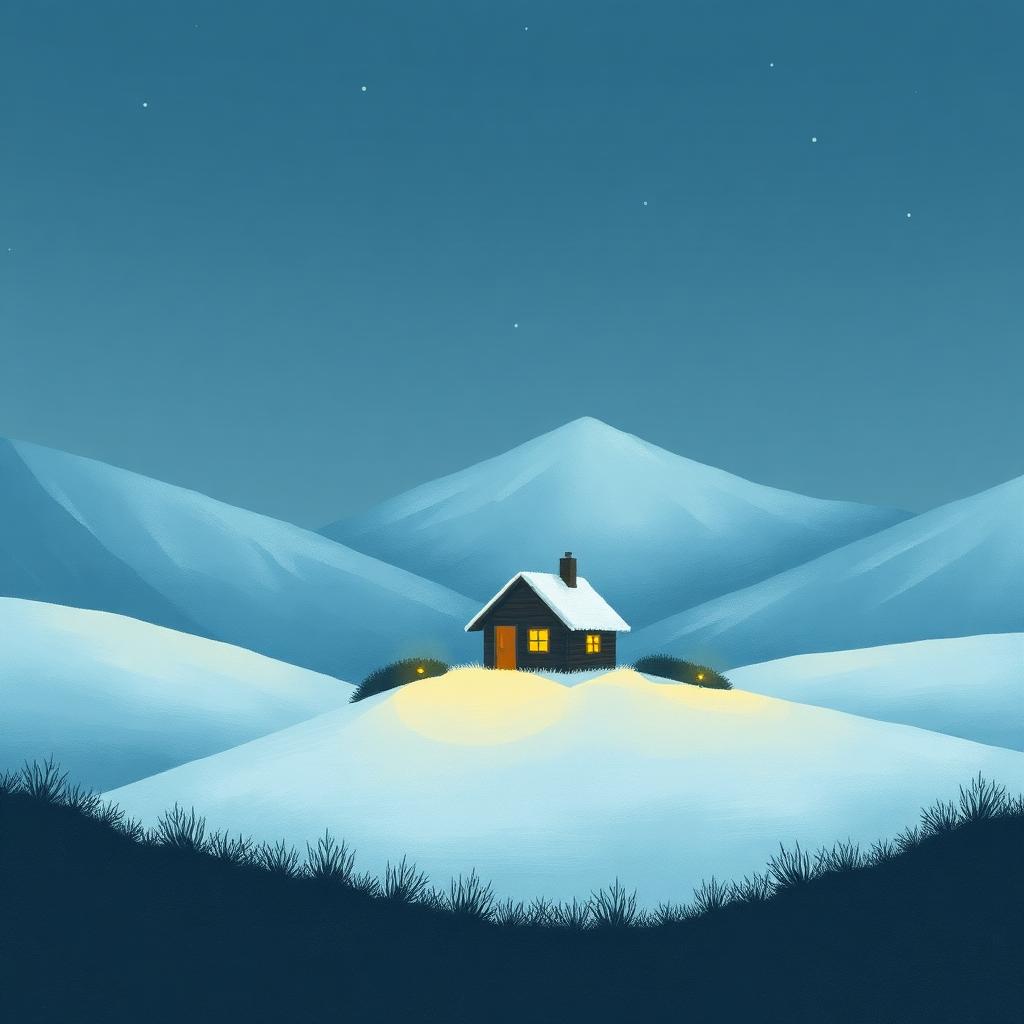
Sleep story · Sleep
The First Snow
Owen Hale · 27 min
27:00
remaining
What to do, minute by minute
1. Get comfortable
0:00–6:45Dim the lights, put your phone face-down, and lie down as if you were already going to sleep. Nothing here needs your effort.
2. Let the words carry you
6:45–13:30Don't try to follow the story closely. Let the images drift past — half-listening is exactly right.
3. Soften the body
13:30–20:15Unclench your jaw, drop your shoulders into the bed, and let your breathing slow on its own.
4. Drift
20:15–27:00If you fall asleep before the end, the session has done its job. If you're still awake, just keep resting — that counts too.
The night a town goes quiet all at once.
Read the full script
At the edge of a wide valley, between low wooded hills and a slow, dark river, there rested a small town of tiled roofs, narrow lanes, and gardens folded behind stone walls.
All through the short afternoon, the sky had been pale and still. It was the color of unpolished silver, soft from one horizon to the other. The hills stood beneath it in shades of brown and deep green. Bare branches made fine patterns against the light. Along the river, reeds bent gently over the water.
The people of the town had noticed the sky.
They had noticed the coolness gathering in doorways, and the way each breath lingered for a moment in the air. They had noticed birds settling early among the hedges, and the faint white rim along the edges of the fountains.
It was the kind of cold that seemed to wait.
By late afternoon, lamps began to glow behind the windows. Their warm light fell across curtains, polished tables, and shelves of well-used books. Chimneys sent thin columns of smoke upward. The smoke rose slowly and then disappeared into the gray.
In the bakery near the square, the last loaves were lifted from wooden shelves and placed into paper bags. A little flour remained on the counter. The ovens gave off a steady warmth. Their heat had seeped into the walls and the floor, and it held the quiet fragrance of bread, toasted grain, and a trace of cinnamon.
Next door, the stationer straightened a row of notebooks and turned a small display of postcards toward the window. Their painted views showed the town in summer, with green trees and bright awnings. Outside, the real square was almost empty.
A bicycle crossed the cobbles. Its wheels made a soft, even hum.
A dog paused beside the stone fountain and looked up at the sky.
Then, so lightly that no one could have said exactly when it began, the first snow arrived.
One small flake moved through the gray air. It drifted past the clock tower and vanished against the dark roof below.
Another followed.
Then another.
The flakes were wide and slow. They did not fall in straight lines. They wandered. They turned once or twice, floated sideways, and settled wherever the air carried them.
One came to rest on the rim of the fountain.
One touched the iron railing outside the library.
Several landed on the shoulders of a man walking home with a paper parcel under his arm. He glanced upward, smiled to himself, and continued along the lane.
The snow thickened gradually.
At first, it melted wherever it landed. The cobbles shone with a fine dampness. Roof tiles grew darker. The bare branches held each flake for only a second before it disappeared.
But the evening grew colder.
A thin white line began to form along the garden walls. The upper edges of gates turned pale. Window ledges gathered little ridges of snow, delicate and soft.
The town continued its evening habits, though everything seemed slower now.
Shopkeepers turned signs in their windows and drew blinds halfway down. A grocer carried a wooden crate inside, brushing snow from its corners. The woman who kept the flower shop tucked potted herbs away from the cold glass. Their leaves trembled briefly as she moved them.
At the café, cups were collected from the tables outside. Each round tabletop already held a light dusting, enough to show the marks of a hand before the snow covered them again.
Doors opened.
Doors closed.
Footsteps crossed thresholds.
Keys turned in locks.
And with every passing minute, the snow softened the sounds.
Wagon wheels no longer clicked so sharply over the stones. Shoes made quieter steps. The fountain’s trickle seemed farther away, hidden beneath the hush gathering around it.
Snow filled the narrow spaces between roof tiles. It rested in the curls of iron balconies and gathered on the old carved letters above doorways.
From an upstairs window, a child watched the square become white.
The child had been sent to bed, but sleep could wait for a few more moments. A blanket was wrapped around small shoulders. Warm breath misted the glass.
Below, lamplight stretched across the snow in long golden shapes. Each flake passing through the light shone for a moment, then dimmed as it moved on.
The clock tower marked the hour.
Its bell rang over the square. The first note was clear. The next seemed softer. The sound traveled over chimneys, across gardens, and down toward the river, where the surface reflected the low clouds.
Then the final note faded.
The child climbed into bed. Curtains remained slightly open, leaving a narrow view of the snow. On the windowsill, a small wooden boat cast a gentle shadow.
In another house, a kettle released the last of its steam.
A book lay open beside a chair. A hand turned one more page. Firelight moved across the paper, warming the black letters and the pale margin. Outside, snow settled on the stack of logs beside the door.
Across the lane, someone folded a wool coat over the back of a chair. Someone else placed slippers beside a bed. A cat made two slow circles on a cushion and tucked its paws beneath its chest.
The ordinary movements of the town became smaller.
Curtains met in the center of windows.
Kitchen taps were turned off.
Latches settled into place.
Lights disappeared, one by one.
Still, the snow went on falling.
It covered the last traces of the day. It filled the shallow grooves made by bicycle tires. It rounded the footprints leading away from the bakery. It laid a smooth white cloth over the square and softened the steps of the town hall.
The fountain wore a cap of snow.
The benches became long white shapes.
The statue in the center of the square stood with snow along its shoulders and folded arms. From a distance, it seemed less like stone and more like a figure patiently waiting in the calm.
Along the oldest lane, houses leaned close together. Their upper stories almost met above the street. Here, the flakes drifted in gentle spirals, sheltered from the open sky.
A single lantern hung over a blue door.
Its glass was cloudy with age, and the flame inside was steady. Snow gathered on the curved metal hood above it. Beneath the lantern, an old pair of boots had been left to dry on a mat. Their soles still held a little mud from the fields.
Farther down the lane, ivy climbed a wall, dark and glossy. Snow caught on each leaf. The vines became outlined in white, as if traced by a careful hand.
Behind the houses, gardens settled beneath the weather.
Rows of winter vegetables disappeared under soft mounds. Clay pots wore white rims. A forgotten watering can rested beside a shed, its handle slowly filling.
Apple trees stood bare and still. Their branches held narrow bands of snow. The smallest twigs seemed almost silver.
A wooden gate remained slightly open.
Beyond it, a path crossed the garden to a low greenhouse. The glass panes were misted from within. A few late herbs grew in the quiet warmth, their green leaves faintly visible.
Snow tapped against the glass.
The sound was so slight that it blended with the settling of the house, the low crackle of a distant stove, and the soft brushing of a branch against a wall.
Near the center of town, the baker finished sweeping the floor.
The long wooden counter was clean. The empty bread baskets were stacked for morning. In a bowl near the window, a little dough rested beneath a cloth, rising slowly in the remaining warmth.
The baker checked the back door, lowered the lamp, and climbed the narrow stairs.
Soon, only the ovens remained awake.
Their bricks released heat little by little. They held the scent of the day’s baking. In the darkness, the metal trays cooled with faint ticks, each one quieter than the last.
Snow leaned against the bakery door.
It covered the stone step.
It rested along the painted letters on the window until the name of the shop looked blurred and sleepy.
At the far end of town, the railway station waited beside two shining tracks.
The final train had passed before the snow began. Now the platform stood empty. The station clock moved steadily. A row of lamps cast soft circles on the white ground.
Snow settled between the rails.
It lined the wooden benches and gathered against the luggage room door. Beneath the roof, a few dry leaves shifted in a corner, moved by a breath of cold air.
The stationmaster walked once along the platform.
A dark coat was buttoned to the neck. A lantern swung slowly at one side. Boots pressed deep, clear shapes into the fresh snow.
At the end of the platform, the stationmaster paused.
The tracks ran east and west, narrowing into the white distance. Usually, the rails carried small sounds from far away. A hum. A vibration. The faint suggestion of movement beyond the hills.
Tonight, there was nothing.
The lantern turned back toward the station. The door opened, releasing a square of warm light, and closed again.
Snow began to fill the footprints.
Beyond the tracks lay open fields. In autumn, they had been brown and gold. Now they were pale beneath the sky, each furrow slowly disappearing.
A fence crossed the field. Snow rested along its top rail. Tufts of dry grass rose here and there, bending beneath small white crowns.
At the field’s edge, the woods waited.
The first row of trees was easy to see. Dark trunks stood evenly spaced. Behind them, the forest deepened into shadow.
Snow fell among the branches.
It landed on mossy stones and old leaves. It gathered on fallen logs and in the hollows of roots. A narrow path leading into the woods remained visible for a while, then softened until it became only a gentle opening between the trees.
An owl shifted on a branch.
Its feathers stirred, then settled.
Somewhere beneath the snow, a tiny stream continued to move. Water slipped between stones, hidden under thin shelves of ice. Its quiet murmur traveled no farther than the nearest bank.
The woods did not resist the silence.
They received it.
Branch by branch, stone by stone, the snow made everything softer.
Back in the town, the last shop light went out.
For a moment, the square seemed darker. Then the eyes could find the smaller lights that remained. A lamp above an inn door. A candle in a high window. The low amber glow of a fire behind curtains.
Snow reflected each one.
The whitened ground held the light and spread it gently, so that the buildings appeared to float in a pale dusk.
The clock tower rose above them all.
Its face shone through the falling snow. The hands moved almost without notice. Around the roof, pigeons slept beneath the eaves, close together and sheltered from the cold.
The minute hand advanced.
No one crossed the square.
No wheels turned.
No shutters moved.
The town had gone quiet all at once, though the quiet had been arriving for hours.
It had come with every closing door and every covered footprint. It had entered the lanes with the snow. It had settled in gardens, beneath benches, on rooftops, and along the riverbank.
Now it seemed complete.
The snow continued, steady and unhurried.
Along the river, flakes touched the dark water and vanished. Near the edges, where the current was slow, a thin skin of ice had begun to form. Snow rested there, creating a fragile border between water and land.
The bridge arched over the river.
Its stone railings were white. A line of lamps crossed from one side to the other, each with a faint halo in the falling snow.
Beneath the center arch, the river moved calmly onward.
It carried dim reflections of the lamps, stretching them into long wavering threads. Each reflection trembled, broke, and joined itself again.
On the opposite bank, a mill stood silent.
The wheel was still. Snow clung to its paddles. A narrow channel beside it moved under a layer of mist, and the mill’s dark windows watched over the water.
Upstairs, behind one of those windows, a room was warm.
A patchwork quilt lay smooth across a bed. A knitted cap hung from a bedpost. On a small table, a glass of water caught a little moonless light from outside.
The person sleeping there had left the curtains open.
Beyond the window, the river, bridge, and town were half hidden by snow. Rooftops faded into the gray. The clock tower appeared and disappeared as thicker veils of flakes passed by.
The room grew quieter.
The house timbers gave a small sigh.
Then nothing stirred.
Hours seemed less important now. The town no longer measured the night by footsteps or traffic, by opening doors or voices in the square.
The night was measured only by the deepening snow.
It rose around the fountain basin.
It climbed the station steps.
It filled the shallow bowl of the birdbath in the garden behind the blue door.
It balanced along fences and lay in folds against walls. It settled over the sloped roofs until every house carried the same soft covering.
The shapes of the town became simple.
Roof and chimney.
Wall and gate.
Tree and path.
Light and shadow.
Even colors rested beneath the white. Red tiles, green doors, brown earth, and gray stone were hidden for the night.
Nothing needed to be bright.
Nothing needed to be hurried.
In the upper streets, where the town met the hills, a row of cottages faced the valley. Their gardens sloped gently downward. From the last cottage, a narrow lane continued toward an orchard.
A porch light glowed.
Snow drifted through its beam, sometimes thick, sometimes thin. Beneath the porch roof, a broom leaned against the wall, ready for morning.
Inside, a fire had burned low.
Only a few red embers remained. Their glow pulsed softly under ash. A wool blanket had slipped toward the floor from an armchair. A pair of spectacles rested on a closed book.
The room held its warmth.
Beyond it, the hallway was dark. The stairs curved upward. Each step knew the quiet weight of the house and the sleeping rooms above.
Outside, the orchard stood in rows.
Snow gathered in the forks of the trees. It covered the old ladder lying beside the shed. It spread across the grass, hiding fallen apples, leaves, and small stones.
At the orchard’s far edge, the land rose toward the hills.
The hills were almost invisible now. Their outlines blended into the sky. A few dark pines marked the ridge, then faded as the snow moved between them and the town.
The air was still enough to hold every flake on every branch.
And yet the snow kept moving downward, layer after layer, without effort.
In the square, the clock prepared to mark another hour.
The mechanism turned within the tower. Old gears moved together, polished by years of patient work. A hammer lifted.
The bell sounded once.
The note spread into the night.
It crossed the rooftops and floated toward the station. It passed over the gardens and the river. It reached the nearest fields, already softened by distance.
Then it faded into the snow.
No echo returned.
The silence closed gently around it.
A little more snow settled on the bridge.
A little more gathered on the lantern above the blue door.
At the bakery, the covered dough continued its slow rising.
At the station, the lamps shone over tracks disappearing beneath white.
In the child’s room, the wooden boat remained on the sill, pointed toward the sleeping town.
All was held in the same calm.
The river moved beneath the bridge.
The embers dimmed beneath their ash.
Snow passed the high windows of the clock tower, turning and drifting in the pale light.
It came down over the square in broad, quiet flakes.
It filled the corners of the lanes.
It rested on every roof and every branch, while the night grew deeper, and the town lay still beneath the first snow, listening only to the soft, endless hush of white settling upon white, lighter than breath, slower than thought, continuing over the gardens, over the river, over the empty fields, and into the darkened woods beyond...