
Sleep story · Sleep
The Mountain Hut
Owen Hale · 30 min
30:00
remaining
What to do, minute by minute
1. Get comfortable
0:00–7:30Dim the lights, put your phone face-down, and lie down as if you were already going to sleep. Nothing here needs your effort.
2. Let the words carry you
7:30–15:00Don't try to follow the story closely. Let the images drift past — half-listening is exactly right.
3. Soften the body
15:00–22:30Unclench your jaw, drop your shoulders into the bed, and let your breathing slow on its own.
4. Drift
22:30–30:00If you fall asleep before the end, the session has done its job. If you're still awake, just keep resting — that counts too.
Above the treeline, a stove, and weather that keeps its distance.
Read the full script
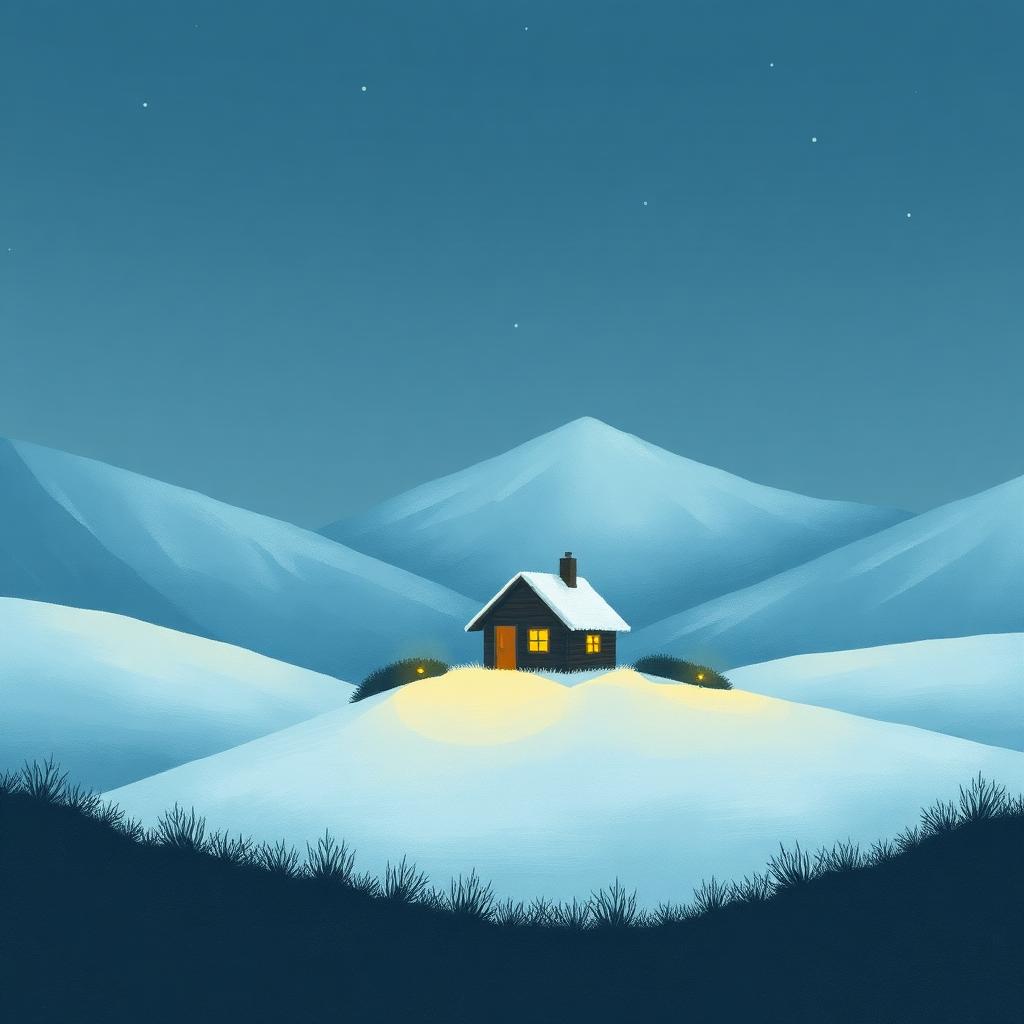
High above the last dark pines, where the mountain slopes open into grass and stone, a small hut rests beneath the evening sky.
Its roof is low and broad. Its walls are built from pale, weathered boards. A single chimney rises at one end, sending a thin ribbon of smoke into the still air.
The hut has stood here through many seasons. Snow has gathered against its door. Summer rain has silvered its roof. Wind has moved over it from every direction, smoothing the grass around its foundations and rounding the edges of the path.
Tonight, the mountain is quiet.
Clouds drift beyond the far ridges, carrying weather through the wide valleys below. From the hut, the rain is only a gray veil in the distance. It passes from one hillside to another, too far away to touch the windows.
Inside, a small iron stove gives off a steady warmth.
The fire has settled into a calm red glow. Now and then, a piece of wood shifts with a soft sound. The stove answers with a faint tick as its metal warms and cools.
Near it, a pair of boots stands on a rough wooden floor.
The boots have been placed side by side, with their toes toward the heat. Their leather is dull from the path, and a few pale crumbs of mountain soil cling to the soles. Damp laces lie loose across their tongues.
A wool coat hangs from a peg beside the door. Beneath it, a narrow bench holds a folded map, a tin cup, and a smooth gray stone picked up somewhere along the trail.
Everything has a place.
The hut’s single room is simple. There is a table beneath the window, two chairs, a shelf of bowls and plates, and a narrow bed tucked under the slope of the roof.
A thick blanket lies across the bed. It is woven in quiet colors. Brown, cream, and a faded green like the grasses outside.
The window is small, but it looks over a great distance.
Beyond the glass, the ground falls away in long, gentle folds. Gray rock gives way to patches of grass, and the grass descends toward the shadowed forest. Farther still, the valley opens, holding a river so distant that it appears only as a pale thread.
On the opposite side of the valley, mountains rise into the deepening blue.
Their highest ridges catch the last light. A narrow line of gold rests along the stone, then slowly thins. The lower slopes are already dim, softened by evening and by the mist that gathers among the trees.
The hut keeps its warm square of light.
Outside, the weather travels along its own quiet paths.
A bank of cloud moves past the western ridge. It gathers, loosens, and changes shape. Rain trails beneath it in long gray strands, but the strands dissolve before they cross the valley.
The windows remain dry.
Only a cool wind reaches the hut, brushing lightly over the roof. It tests the chimney, circles the walls, and continues on.
The door fits firmly in its frame. A simple iron latch holds it closed. Around the edges, there is no whistle and no draft, only the low hush of the mountain air passing by outside.
Within the room, the stove continues its patient work.
A small kettle rests on top. Its blue enamel is marked with tiny chips around the rim. Heat gathers beneath it. From the spout comes the faintest breath of steam.
A hand lifts the kettle and pours water into the tin cup on the bench.
The water catches the stove light as it falls. A little steam rises, carrying the dry scent of mountain herbs. Leaves turn slowly beneath the surface, then settle at the bottom.
The cup is carried to the table.
The chair makes a soft scrape against the floor. Then the room is still again.
From here, the window frames the valley like a quiet painting. The distant rain darkens one slope while another grows clear. A cloud opens, revealing a pale patch of sky. Then it closes again.
Nothing asks to be hurried.
The cup rests between two hands. Its warmth passes through the metal. The table is worn smooth near the edge, polished over the years by sleeves, palms, and folded maps.
There are shallow marks in the wood. A curved line. A small dent. A dark ring left by another cup on another evening.
The hut remembers without needing to speak.
Beneath the table, the floorboards hold the warmth from the stove. The grain runs in long lines from wall to wall. Small knots make dark islands in the pale wood.
Near the door, a broom leans in the corner. A few dry grass stems rest beneath it, carried in on boots from the path.
Outside that door, the path bends around the hut and continues upward.
It crosses a slope of short grass and scattered stones. It passes a spring where clear water gathers in a shallow basin. Then it climbs toward a saddle between two rounded peaks.
At this hour, no one is walking there.
The path lies empty beneath the changing sky. Its stones grow cool. The tufts of grass beside it bend and lift beneath the wind.
Tiny alpine flowers have closed their petals for the night. They rest close to the ground, sheltered by stones. Their colors are hidden now, folded inward until morning.
Higher up, the ridge has begun to disappear into cloud.
The cloud arrives without weight or hurry. It touches the summit and spills gently over the far side. For a little while, the ridge looks softer, as though covered in pale wool.
Then the wind draws the cloud away.
The dark outline returns, calm and familiar.
Inside, another piece of wood is placed in the stove.
The stove door opens, and a mellow orange light spreads across the floor. The wood settles onto the embers. For a moment, small flames move along its edge.
Then the iron door closes.
The room grows dim again, though the warmth continues to deepen.
The cup is nearly empty now. A few leaves remain at the bottom, resting in a crescent of amber water.
It is set beside the folded map.
The map shows the mountain in fine brown lines. Each line curls around slopes and valleys, gathering close at steep cliffs and widening across open meadows.
A blue line marks the river.
A dotted path travels from the forest to the hut, then beyond it to the high saddle. On paper, the distance seems small. A fingertip could follow the whole route in a moment.
But the mountain keeps a slower measure.
It counts distance in steady steps. In bends of the trail. In places where water runs over stone. In the changing scent of pine, wet earth, grass, and cold air.
Below the treeline, the path passes through a forest where the ground is soft with needles.
The trees stand close together there. Their trunks rise straight and dark. Small streams cross the trail, carrying the chill of shaded ground.
Farther up, the trees grow lower and farther apart.
Then, at last, the forest ends.
The final pines lean away from the open slope, their branches shaped by years of wind. Beyond them lies the broad, treeless mountain, with the hut resting above it like a small, warm thought.
The light outside continues to fade.
The golden edge has left the highest peaks. The stones are blue-gray now. The valley has deepened into shadow, and the forest has become one dark sweep.
Here and there, mist gathers between the ridges.
It does not rise toward the hut. It remains below, filling hollows and drifting over the river. It moves so slowly that its motion is almost impossible to see.
A lamp is lit on the table.
Its flame is small. A glass chimney protects it, and the light settles gently across the room.
It touches the rim of the cup and the brass buckle of a pack beneath the bench. It reaches the stove, where the black iron reflects a soft amber curve.
The corners stay dim.
Above the bed, the roof beams cross in quiet shadows. They are broad and rough, still showing the marks of the tools that shaped them.
A sprig of dried mountain thyme hangs from one beam. Its tiny leaves have faded to gray-green. When warm air rises from the stove, the sprig turns almost imperceptibly.
The room smells of woodsmoke, wool, dry herbs, and clean evening air.
The window is opened for a moment.
Coolness enters at once.
It moves over the table and across the floor, fresh from the high slopes. It carries the scent of stone and distant rain.
Outside, there is a vast, quiet hush.
Somewhere far down the mountainside, water slips through a narrow channel. Its sound cannot quite be heard from here, yet the valley seems shaped by it.
The wind has softened.
A loose strand of cloud drifts above the roof. A few drops of rain fall from it, tapping lightly against the window ledge. One drop darkens the wood. Another rests on the glass.
Then the cloud moves on.
The brief shower is over before it begins.
The weather remains at a distance, circling the mountain, passing through neighboring valleys and over ridges that are already lost in the blue dark.
The window closes.
The latch turns, and the room gathers around its warmth once more.
The coat on the peg has begun to dry. Its folds hang heavily at first, then soften as the stove heats the wool.
The boots no longer shine with dampness. A little soil flakes from one heel and falls silently to the floor.
The lamp burns steadily.
There is nowhere else to go tonight.
The path can wait beneath the stars and clouds. The saddle can wait. The spring can continue filling its stone basin, drop by clear drop.
The map remains folded.
The pack remains buckled.
The hut asks for nothing beyond the simple tending of the stove.
One more log lies in the basket. Its bark is pale and papery. The cut end shows rings gathered tightly around a small center.
It will not be needed yet.
The present fire is enough.
Behind the stove door, flames have become low and even. They move without crackling, quietly drawing warmth from the wood. Red light shows through the tiny vent.
The kettle is moved aside.
Its metal cools with soft, occasional clicks.
Across the room, the bed waits beneath the sloping roof.
The blanket is drawn back. Underneath, the sheet is cool and smooth. A pillow rests against the wooden wall, covered in plain white linen.
The lamp is carried nearer.
Its circle of light shifts across the floorboards. The table recedes into shadow. The cup and map become quiet shapes. The window turns dark and begins to reflect the room.
For a moment, both views exist together.
The dim bed and stove appear in the glass. Beyond them, faintly, the mountains remain.
The reflection of the lamp floats over the valley like a small golden star.
Far below, another light appears.
It may be a farmhouse window at the edge of the forest, or a lantern moving beside the river. It is too distant to tell.
It glows for a while, steady and small.
Between that light and the hut lie miles of dark trees, open slopes, and sleeping stone. Yet the distance feels gentle. Each light keeps to its own place.
The clouds continue eastward.
A gap opens among them, and a few stars become visible above the ridge. They are sharp in the cold air. One, then another, then several more.
Their light reaches the roof, the path, and the shallow basin at the spring.
The water there holds a dark reflection of the sky. A blade of grass leans over the edge. The surface trembles once beneath the passing wind, then becomes still.
Near the hut, stones release the last warmth of the day.
The grass settles around them.
Small night moths remain hidden beneath leaves and in narrow cracks. Nothing stirs near the door.
Inside, the lamp is turned low.
Its flame shortens. Shadows rise along the walls. The stove becomes the brightest thing in the room, though even its glow is muted behind iron.
The blanket is lifted and allowed to settle.
Its weight spreads evenly across the bed. The wool is warm from the room, soft at the edges, a little rough where it has been woven tightly.
The pillow gives beneath a resting head.
From here, the roof is close overhead. The beams look darker now. The dried thyme no longer moves.
The hut makes its nighttime sounds.
A board shifts as the warmth changes.
The kettle gives one last quiet tick.
A small ember settles in the stove.
Then silence fills the spaces between those sounds.
It is not an empty silence.
It contains the wind passing beyond the walls. It contains the distant weather, the high spring, the still path, and the forest far below.
It contains the whole slow mountain night.
The lamp is lowered once more.
The room becomes softer.
Only a small amber circle remains on the bedside shelf. Within it sits the smooth stone from the trail, gray by day and almost silver now.
Its surface is crossed by a thin white line.
Perhaps it came from the stream below the treeline. Perhaps from the open slope above the hut. Its journey no longer matters.
It rests where it was placed.
On the table, the folded map rests too.
The lines of ridges and rivers are hidden inside it. The paths have disappeared between the folds.
Outside, the actual paths are disappearing into darkness.
The nearest bend is still faintly visible. Beyond it, the trail blends with the grass. Higher up, it passes into cloud shadow and cannot be followed at all.
Morning will bring it back.
For now, the mountain needs no map.
The stove breathes out its steady heat.
Warm air rises, touches the roof beams, and moves slowly down the walls. The blanket holds that warmth close.
Beyond the window, stars brighten and fade as thin clouds cross them.
One cloud passes over the summit.
Another stretches above the valley, narrow and pale. Its underside catches a little distant moonlight, though the moon itself remains hidden.
The rain is farther away now.
It moves along another range, beyond the visible ridges. No sound of thunder reaches the hut. No gust shakes the door.
Weather travels where it will, but here the roof is dry.
Here the chimney draws cleanly.
Here the fire is settled.
The last light in the valley disappears.
The small distant window, or lantern, is gone. The forest rests in darkness from one slope to the next.
The river continues under the night, unseen.
Its pale thread has vanished, yet its water keeps moving around stones and beneath overhanging branches. It widens in quiet pools. It narrows between banks of moss.
High above, the spring keeps feeding it.
Drop by drop, the basin fills. A little water spills over the rim and enters a shallow channel in the grass. The channel winds down toward the trees.
Everything moves slowly.
Clouds across the sky.
Water down the mountain.
Warmth through the room.
Breath beneath the blanket.
The lamp flame leans once, then stands upright.
Its light has become very small now.
The edges of the shelf fade. The white line in the stone disappears. The roof beams merge with the dark.
Only the window keeps a faint blue-gray square.
Within it, one clear star remains.
The star seems still, though the clouds move around it. A thin veil passes, and the light softens. The veil thins, and the star returns.
The wind circles the hut once more.
It brushes over the roof with a long, low hush. It moves around the corner near the chimney, crosses the open slope, and travels upward toward the saddle.
There, it slips between the two rounded peaks and is gone.
The hut remains.
Its boards are warm on the inside and cool on the outside. Its latch is secure. Its chimney releases a fading ribbon of smoke.
The stove has settled to embers.
Deep within, a red glow holds beneath a covering of ash. It will last for hours, quiet and steady.
The lamp is extinguished.
For a moment, the room is completely dark.
Then the eye finds the window again, and the window finds the sky.
The cloud has passed.
More stars rest above the mountain, clear and distant. They cast no sharp shadows. Their light is too gentle for that.
It lies faintly on the roof and the stones near the path.
Inside, the blanket rises and falls.
The coat hangs still.
The boots wait beside the stove.
The kettle, the cup, the map, and the small gray stone are all quiet in their places.
No steps approach along the path.
No hand lifts the latch.
Only the mountain night remains, broad and unhurried.
Far away, rain continues to fall over another valley. It darkens the stone there and beads on the needles of trees. It gathers in leaves, drops into streams, and moves onward.
Here, the windows stay dry.
The hut keeps its small pocket of warmth beneath the stars.
The stove cools slowly.
The roof holds steady above the bed.
And the wind, having crossed the high saddle, drifts down the far slope, through grasses that bend and settle, past stones that keep their silence, into a deep and hidden valley where clouds lie low and the night grows softer, darker, and quieter still.