
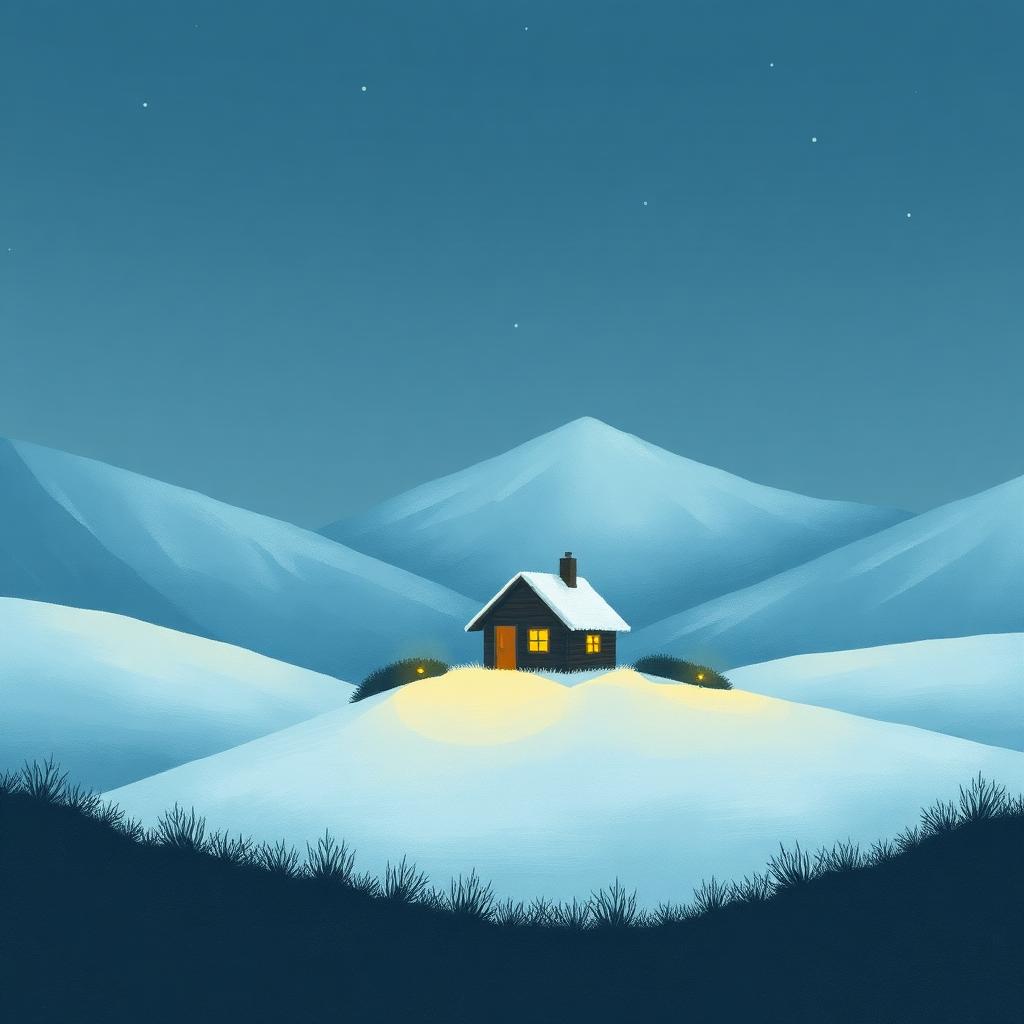
Sleep story · Sleep
The Winter Cabin
Owen Hale · 28 min
28:00
remaining
What to do, minute by minute
1. Get comfortable
0:00–7:00Dim the lights, put your phone face-down, and lie down as if you were already going to sleep. Nothing here needs your effort.
2. Let the words carry you
7:00–14:00Don't try to follow the story closely. Let the images drift past — half-listening is exactly right.
3. Soften the body
14:00–21:00Unclench your jaw, drop your shoulders into the bed, and let your breathing slow on its own.
4. Drift
21:00–28:00If you fall asleep before the end, the session has done its job. If you're still awake, just keep resting — that counts too.
Snow, a kettle, and a night with nowhere else to be.
Read the full script
By late afternoon, the snow has covered the narrow path to the cabin.
It lies softly over the hillside, smoothing the stones and filling the shallow places between the roots of the pines. Every branch holds a quiet white line. Every stump wears a rounded cap. Beyond the trees, the sky is pale and close, and more snow drifts down without hurry.
The cabin rests in a small clearing.
Its roof slopes beneath a deepening layer of white. A thin ribbon of smoke rises from the chimney, bending once in the still air before fading into the gray. Warm light gathers behind two square windows. From a distance, the glass looks amber, like a pair of lanterns set among the dark trunks.
Inside, a traveler has already taken off a heavy coat.
It hangs from a wooden peg beside the door. A scarf rests over one sleeve, and a pair of boots stands neatly on the mat below. Small beads of melted snow shine along the leather. Now and then, one slips down and disappears into the woven wool.
There is nowhere else to be tonight.
The road through the valley is quiet. The nearest village lies beyond the ridge, where a few windows will also be glowing under the snow. No one is expected at the cabin. No errands wait. No plans need to be made.
The evening has only a fire, a kettle, and the slow arrival of night.
The traveler crosses the room in thick socks. The floorboards are old and smooth. They make a low, familiar sound beneath each step.
Near the stove sits a basket of split wood. The pieces are pale at their cut ends and dark along the bark. One log is lifted and placed carefully inside. The iron door closes with a soft click.
For a moment, the fire shifts.
A small flame curls around the new wood. It brightens, settles, and brightens again. The stove gives off a steady warmth that reaches the chair beside it, the braided rug, and the edge of the narrow table.
On the table waits a blue enamel kettle.
Its handle is folded down against its side. Tiny scratches mark the surface, left by many winters and many evenings much like this one. The traveler fills it from a stoneware jug. Water sounds briefly against metal, clear and hollow in the quiet room.
Then the kettle is placed on the stove.
Nothing needs to happen quickly.
The water can warm in its own time. The fire can find its way through the fresh log. The snow can continue beyond the windows, falling through the darkening air.
The traveler moves to the nearest window and wipes a faint mist from the lower corner of the glass.
Outside, the clearing is already changing.
The path that was visible an hour ago has almost vanished. A shallow curve remains where footsteps pressed into the snow, but the edges are softening. Fresh flakes rest over the old tracks. Soon the way to the door will be a smooth white slope again.
A pine branch dips under the added weight.
It lowers by the smallest amount, then holds still. Another branch stirs above it. Powder slips free and falls in a gentle veil. For a few seconds, the air beneath the tree is full of sparkling white.
Then all is quiet again.
The window glass feels cool. The room behind it feels warm.
The traveler lets the curtain fall back into place and turns toward the fire. A chair waits there, wide enough to sit deeply, with a faded cushion and a wool blanket folded over one arm.
The blanket is gray, crossed with thin lines of rust and cream. Its weave is soft from years of use. When the traveler unfolds it, it gives a dry whisper. It settles across the knees and down to the ankles, holding the stove’s warmth close.
Beside the chair is a low shelf of books.
Their cloth covers have softened at the corners. Some lean together. Some lie flat beneath a small wooden box. There are old field guides, stories of distant coasts, collections of recipes, and a book filled with drawings of winter birds.
The traveler chooses the book of birds and opens it somewhere near the middle.
A small brown owl looks out from the page.
Its feathers are drawn in fine lines, each one shaded differently. Beneath it, a few sentences describe the quiet woods it prefers, the hollow trees where it rests, and the pale evenings when it moves between the branches without sound.
The traveler reads a page, then another.
Outside, snow passes the window.
Inside, the kettle begins to make the faintest murmur.
At first, it is no more than a shift in the water. A small movement against the metal. Then comes another, softer than the fire, softer even than the turning of a page.
The traveler lowers the book and listens.
The cabin has many small sounds when no one asks it to be silent.
There is the low flame inside the stove. The occasional settling of wood. The tiny tapping of snow against the window. The floorboards responding to warmth. The soft movement of water in the kettle.
Together, these sounds fill the room without disturbing it.
They rise and fade. They return. They leave space between them.
The kettle’s murmur grows rounder.
The traveler closes the book, keeping one finger between the pages, and goes to the table. A mug stands beside a small tin. When the tin is opened, the dry scent of mint and chamomile drifts upward. A spoonful is tipped into a strainer.
The kettle is not quite ready.
There is time to wait.
The traveler rests one hand on the back of the chair and looks toward the second window. This one faces the woods. The trunks appear close together now, dark and straight in the blue-gray evening.
Farther between them, the shapes fade.
Snow collects in the spaces where branches divide. It gathers along one side of each trunk, making narrow white ribbons that climb into the dimness. No animal crosses the clearing. No wind moves through the high needles.
The whole hillside seems to be resting beneath the weather.
A small sound comes from the stove.
The kettle lid trembles once, then rests. Steam begins to rise from the spout in a thin, nearly invisible thread.
The traveler wraps a cloth around the handle and lifts the kettle. Hot water flows into the mug. The herbs turn and open. A warm green scent spreads through the cabin, mingling with pinewood, wool, and the faint mineral coolness near the windows.
The kettle is returned to the stove, but not to the hottest place.
It will stay warm there through the evening.
The mug is carried carefully to the chair. The traveler sits again and draws the blanket close. Both hands circle the cup.
For a while, there is only warmth.
Warmth from the mug against the palms. Warmth from the stove across the legs. Warmth held in the blanket and gathered inside the little room while winter deepens outside.
The tea is still too hot to drink, so the traveler waits.
Steam drifts upward and disappears.
The book remains closed on the table. The lamp beside it casts a low circle of gold. Beyond that circle, the corners of the cabin grow dim. A row of pegs stands along the far wall. A broom leans near the door. A copper pan catches one edge of the lamplight.
Everything has its place.
Nothing needs attention.
When the tea cools, the traveler takes a small sip.
It tastes mild and grassy, with a trace of sweetness. The cup returns to both hands. Another sip follows after a long while.
The snow keeps falling.
There is no need to measure the evening. It can pass by cups of tea, by logs added to the stove, by the slow darkening of the windows.
Outside, the pale sky turns blue, then charcoal. The clearing becomes a soft shape framed by the glass. The nearest branches remain visible, carrying their white layers. Beyond them, the forest blends into night.
The traveler reaches for the lamp and turns its wick a little lower.
The room softens.
The bright edges fade from the table and shelves. The stove window glows more clearly now, a small rectangle of red and orange. The fire has settled into a steady bed of coals, with low flames moving over the wood.
The traveler opens the bird book again.
There are drawings of chickadees on snowy twigs. A nuthatch clings to the side of a trunk. A grouse leaves a row of delicate marks across an empty field.
The traveler follows the printed tracks with one finger.
They begin near a cluster of grasses, cross the white page, and disappear at the edge. There is no need to know where they lead. They are simply there for a time, small impressions in drawn snow.
Another page turns.
The paper makes a quiet brushing sound.
Then another.
The traveler reads less now. The pictures are enough. Gray feathers. Fine claws around narrow branches. Wings folded close against winter air.
Sometimes the same line is read twice.
Sometimes the eyes remain on one page without taking in the words. Attention drifts toward the fire, then toward the snow, then back to the book.
Nothing is lost when it wanders.
The room remains warm. The chair remains deep and steady. The evening asks for nothing more.
After a while, the book closes by itself beneath the traveler’s relaxed hand.
The empty mug rests on the table.
A little warmth remains in its base. The herbs have settled at the bottom of the strainer. Their scent is faint now, but still present when the traveler leans near.
The kettle waits on the stove.
Its earlier murmur has gone quiet. It holds the remaining water, warm and still.
The traveler stands and stretches slowly. The blanket slips from the knees and gathers in the chair. A few steps cross the room. The mug is rinsed in a basin, the strainer emptied, the spoon dried and returned to the drawer.
Each small task is simple.
Water over clay. Cloth over metal. A drawer opening and closing.
The traveler wipes the table once, though it is already clean. The lamp is carried to the narrow sleeping room at the back of the cabin.
The room is small beneath the sloping roof.
A wooden bed stands against one wall. There is a chest at its foot, a washstand near the door, and a single window under the eaves. A quilt covers the bed in squares of deep blue, faded green, and soft brown.
The traveler turns down one corner.
Beneath the quilt lie two blankets and smooth cotton sheets. A hot-water bottle, wrapped in knitted wool, waits on the washstand.
Back in the main room, the kettle is lifted again.
The water pours with a low, gentle sound. The wool-covered bottle grows warm and heavy. Its cap is tightened, and the traveler carries it to the bed, placing it beneath the blankets near the foot.
Soon the sheets will hold a pocket of warmth.
The lamp remains on the washstand while the traveler returns to the stove.
One last log is chosen from the basket.
It is smaller than the others, dry and cleanly split. The traveler sets it onto the coals and watches until a flame catches along its edge. The stove door closes. The latch settles.
By morning, the fire may be only ash and a few dim embers.
For now, it is enough.
The curtains in the main room are drawn. First one, then the other. The dark windows disappear behind thick fabric. The cabin seems smaller afterward, more enclosed, its warm circle complete.
The traveler checks the door.
The latch is secure. The coat hangs undisturbed. The boots are drying on the mat. Their damp shine has faded.
Nothing else waits.
The lamp is lowered again.
Its flame becomes a small golden bead. The traveler carries it down the short passage to the sleeping room, where shadows move gently across the sloped ceiling.
The cabin settles around the returning warmth.
A beam gives a quiet creak. Snow slides somewhere along the roof, not far, then stops. The sound is soft and heavy, like a blanket being adjusted.
The traveler changes into warm nightclothes and folds the day’s clothes over the chest.
Socks remain on for a little while longer.
The quilt lifts. Cool air slips beneath it, followed by the traveler, and then the layers settle again.
The hot-water bottle has warmed the lower sheets. Feet find it and rest nearby. The heat comes through the wool cover slowly, never too much at once.
The pillow is turned to its cooler side.
The traveler lies back.
From the bed, only a little of the room can be seen. The curve of the ceiling. The edge of the washstand. The lamp’s faint glow. The dark square of the curtained window.
Beyond the wall, the stove continues its low work.
There is a muted crackle, then stillness. The chimney draws softly. Somewhere outside, snow touches snow.
The traveler listens without trying to name each sound.
Some are close. Some are distant. Some may belong to the cabin, and some to the trees. Each one appears for a moment and fades into the winter night.
The lamp flame is lowered until it is barely there.
The colors of the quilt deepen. Blue becomes almost black. Green turns to shadow. The wooden walls lose their grain and become broad, quiet shapes.
The traveler pulls the blankets higher.
Warmth gathers around the shoulders. The pillow receives the weight of the head. The mattress holds the body without any need to shift.
Outside, the snowfall continues through the dark.
Flakes descend past the roof and settle along the eaves. They fill the old footprints completely. They gather on the woodpile beneath its shelter, on the railing beside the step, on the needles of the pines.
No one is walking the hidden path now.
No lantern moves between the trees. No wheels turn along the valley road. The night is spacious and unoccupied.
Inside, the kettle cools on the stove.
The metal gives a tiny click as it changes temperature. The cup stands upside down on its cloth. The bird book rests where it was left, closed around a page of winter wings.
The chair keeps the shape of the folded blanket.
The fire lowers.
Red coals breathe behind the iron door, brightening when the chimney draws, darkening when the air grows still. The last log shifts inward by a fraction. Ash gathers along its edge.
In the sleeping room, the lamp goes out.
Darkness arrives gently, already warmed by everything that came before.
The traveler’s eyes close.
The cabin remains around the bed. Four walls beneath a snow-covered roof. A door fastened against the cold. A stove holding the last heat of evening.
The sounds grow fewer.
A soft tick from the cooling kettle.
A faint movement in the rafters.
The long, nearly silent fall of snow.
The traveler sinks more deeply into the mattress. The feet remain warm near the wool-covered bottle. Hands rest beneath the blanket. The weight of the quilt lies evenly from shoulders to toes.
Nothing needs to be finished tonight.
The path can wait beneath the snow. The books can wait on their shelf. The cooled kettle can wait beside the fading fire.
Morning is somewhere beyond the dark, but it is far away and in no hurry.
For now, there is only the cabin.
Only the quiet room.
Only the roof under its deep white covering, the pines standing close around the clearing, and the soft weather continuing beyond the walls.
Snow settles on every branch.
It smooths every hollow.
It drifts against the step and gathers beneath the windows, light upon light, layer upon layer.
And inside, the last ember dims beneath a veil of ash, holding one small point of warmth while the night grows deeper, and quieter, and softer still...